
Accessing low-cost carrier (LCC) content is only the first challenge.
Retailing LCC content effectively at scale — while driving growth and protecting margin — is the bigger challenge.
Travel Sellers need more than content and inventory. They need accurate search, reliable booking, ancillary retailing, flexible payments, fulfilment and post-booking servicing — all designed to increase conversion and revenue without requiring them to build and maintain a different workflow for every airline.
That changes how businesses should evaluate a flight API partner.
Connectivity still matters. But the bigger question is:
How much airline complexity can the infrastructure remove from your business – and how much incremental growth can it unlock?
For LCCs, that means looking across the complete retailing journey:
Search → Retail → Book → Pay → Fulfil → Service → Intelligence
This guide looks at what Travel Sellers should evaluate when choosing an LCC flight API or airline retailing partner, and how platforms including Atlas, Travelfusion, Kyte and Duffel approach the problem differently.
What is LCC retailing infrastructure?
An LCC flight API gives Travel Sellers a way to connect to low-cost airline content without building a separate technical integration for every carrier.
But connectivity is only one layer.
LCCs can have very different requirements around fares, baggage, seats, branded products, payment, ticketing and servicing. Those differences become an operational challenge as airline coverage grows.
Modern LCC retailing infrastructure therefore needs to support more than access to airline content. It should help manage the full transaction lifecycle and help Travel Sellers sell more effectively:
- Search — retrieve relevant flight offers and availability.
- Retail — present fares, baggage, seats and other ancillary products.
- Book — create and confirm reservations reliably.
- Pay — support airline-specific payment and settlement requirements.
- Fulfil — complete booking and ticketing workflows.
- Service — support refunds, changes, cancellations, VOID and other post-booking requests.
- Intelligence — monitor performance and use data or automation to improve operations.
For a Travel Seller scaling across multiple LCCs, the important question is not simply:
“How many airlines can I connect to?”
It is:
“How much airline-specific complexity will the infrastructure remove and how effectively will it help me scale, convert and grow?”
What should Travel Sellers look for in an LCC flight API?
-
Airline coverage and connectivity model
Airline count matters, but the number alone does not explain how that content reaches your platform.
Travel Sellers should understand:
- Which airlines are available in their priority markets
- How each airline is connected
- How frequently fares and availability are updated
- Which ancillary and servicing capabilities are supported by carrier
- How much airline-specific implementation remains with the Travel Seller
The important distinction is breadth plus depth.
A large network can provide valuable reach. But businesses should also understand the connectivity, retailing and fulfilment capabilities available behind that network.
-
Search accuracy and booking reliability
A fast search response means little if the fare cannot be booked when the traveller reaches checkout.
When evaluating a flight API, consider:
- Search response performance
- Fare accuracy
- Availability verification
- Booking success
- Airline error handling
- Timeouts and retries
- Look-to-book management
- Performance monitoring
The goal is not simply to return flight content. It is to turn that content into successfully fulfilled bookings.
-
Ancillary and fare retailing
Ancillaries are fundamental to the LCC model. Depending on the airline, these can include:
- Checked and cabin baggage
- Seat selection
- Branded fares
- Priority services
- Other airline-specific products
Travel Sellers should also look at when these products can be sold. Can baggage be added during booking? Can an extra bag be added after booking? Are seats supported consistently? Does the provider expose branded fares in a structured way?
The deeper the LCC portfolio becomes, the more important this operational detail becomes.
-
Payment and fulfilment
Different airlines can require different approaches to payment, settlement and ticketing.
A Travel Seller may need to manage:
- Pre-payment accounts
- Virtual credit cards (VCC) passthrough
- Multiple currencies
- Airline-specific payment rules
- Different confirmation and fulfilment processes
The airline connection therefore solves only part of the problem.
Payment and fulfilment determine whether a flight offer can become a completed booking.
-
Post-booking servicing
For many Travel Sellers, some of the greatest operational complexities begin after the booking is completed.
Businesses should evaluate support for:
- Booking retrieval
- Post-booking baggage and ancillaries
- Flight changes and cancellations
- Refunds and VOID
- Airline schedule changes
- Booking and service-status visibility
Availability will vary by airline, but the wider question is important:
How much of the servicing workflow can be standardised or automated instead of handled manually?
-
Operational visibility
As airline coverage scales, Travel Sellers need visibility into what is happening across the distribution layer. That can include:
- Airline performance
- Search and booking funnels
- Fare or availability issues
- Fulfilment status
- Post-booking requests
- API errors
- Response times
- Service notifications
This is where the difference between an API and an infrastructure platform becomes more meaningful.
An API connects systems. Infrastructure should also help businesses operate what happens around that connection.
-
AI and agent readiness
A new requirement is emerging alongside traditional OTA, TMC and metasearch distribution: AI agents that interact with live airline infrastructure.
For an AI travel product, an endpoint alone is not enough.
The infrastructure needs structured, machine-readable responses, live availability and predictable transactional workflows. And when an agent can take consequential actions such as booking or paying, clear controls are needed around what the agent is authorised to decide.
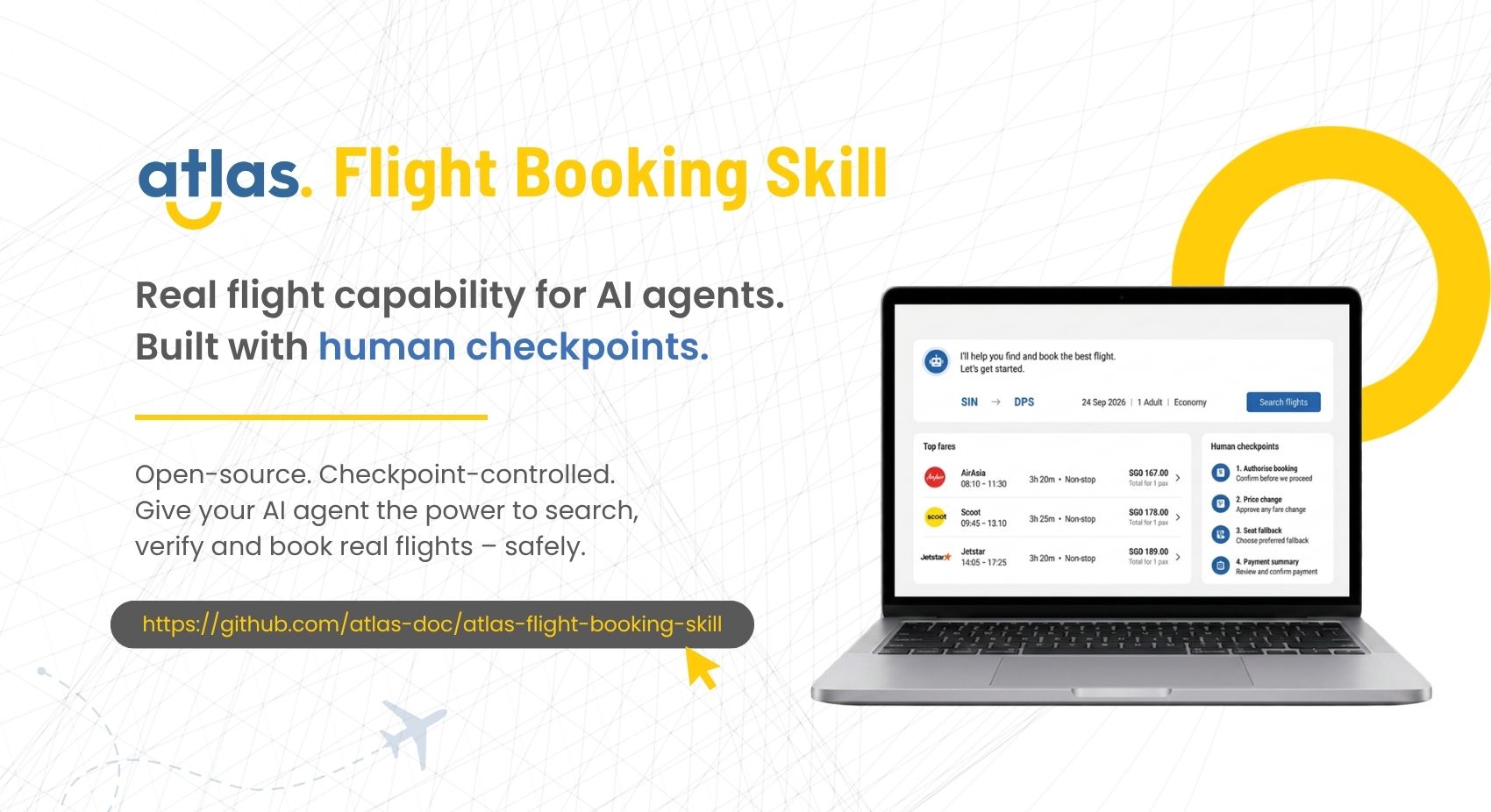
Atlas has begun extending its flight infrastructure into this area through its open-source Flight Booking Skill. The current release gives compatible AI agents live flight search, fare verification and controlled booking, with explicit human approval checkpoints around consequential actions.
This introduces another consideration for Travel Sellers and travel-tech builders:
Can the infrastructure support both today’s booking applications and tomorrow’s agent-driven interfaces?
-
Trust and delivery resilience
For AI-native Travel Sellers, infrastructure reliability becomes more than an operational consideration. It becomes part of the trust between the traveller and the product.
When a traveller books through an AI-powered interface, they may never see the airline systems, fulfilment providers or other infrastructure operating behind the experience. But they will experience the outcome.
If a booking fails to fulfil, a change cannot be serviced, or a refund disappears into a broken workflow, the traveller is unlikely to distinguish between the AI Travel Seller and the third-party infrastructure behind it.
The failure belongs to the product in the traveller’s eyes.
This makes trust an increasingly important factor when evaluating airline retailing infrastructure, particularly for newer AI-native Travel Sellers that may not have the multiple supplier relationships and fallback options available to larger OTAs.
Travel Sellers should therefore consider:
- How reliably bookings are fulfilled
- How failures and exceptions are handled
- Whether post-booking services can be depended on
- What operational visibility is available when something goes wrong
- Whether there are escalation and recovery processes
- How consistently the provider performs across the airlines that matter to the business
For AI-native travel in particular, trust will be built not only by how well an agent finds and recommends a flight, but by whether the infrastructure behind it reliably delivers what the agent has promised.
Atlas vs Travelfusion vs Kyte vs Duffel
There is no single best flight API for every Travel Seller.
Atlas, Travelfusion, Kyte and Duffel solve overlapping problems, but their public positioning, distribution models and areas of focus differ.
| Dimension | Atlas | Travelfusion | Kyte | Duffel |
|---|---|---|---|---|
| Core focus | LCC retailing and fulfilment infrastructure | Global LCC/NDC aggregation and distribution | Direct-connect airline API infrastructure | Developer-focused multi-source flight platform |
| Published airline coverage | 140+ LCCs | 400+ LCCs + 70+ NDC airlines | NDC and LCC content through KDC Network | 300+ airlines |
| Connectivity model | Single integration across NDC, API and direct airline sources | Single API across LCC, NDC/FSC and consolidator content | Kyte Direct Connect Network via JSON/REST API | One integration across NDC, GDS and LCC channels |
| Ancillary retailing | Baggage, seats and branded fares for supported airlines | Baggage, seats, meals, branded fares and other ancillaries | Baggage, seats, meals and other supported ancillaries | Baggage and seats |
| Post-booking | Refunds, VOID, passenger information correction, changes, cancellations and supported post-booking ancillaries | Changes, cancellations, VOID and post-booking ancillaries | Changes, cancellations, schedule changes and other supported servicing | Changes, cancellations and order management |
| Operational layer | ATRIP – a platform for booking management and servicing, webhooks and AI-powered operations | MI dashboard, supplier management and real-time reporting | Primarily API and network-led workflows | API plus order-management tooling |
| Distinctive public focus | LCC operational depth, retailing and fulfilment infrastructure and AI-native workflows | Distribution breadth and mature aggregation | Standardised direct airline connectivity | Developer experience and simplified multi-source access |
Important: These platforms have overlapping capabilities and solve different distribution problems. The comparison above reflects current public positioning and documented capabilities rather than suggesting that a feature not mentioned is unavailable. Exact content, ancillary and servicing functionality can also vary by airline and commercial setup.
The important conclusion is therefore not that one platform provides retailing while another only provides content.
The real distinction is what each platform has been built and optimised to do.
How should you compare LCC flight API and retailing platforms?
Atlas, Travelfusion, Kyte and Duffel overlap in several areas, but they have been built with different priorities and operating models.
That means the right comparison should not start with:
“Which provider has the most features or airlines?”
It should start with:
“What problem are we trying to solve?”
A Travel Seller prioritising broad global airline distribution may evaluate providers differently from one focused on deeper LCC retailing and fulfilment.
A team building a new travel application may place greater weight on developer experience and implementation simplicity.
A business managing high volumes of LCC transactions may care more about ancillary coverage, booking reliability, payment flexibility, servicing automation and operational visibility.
And a company evaluating a Travelfusion alternative may not necessarily be looking for a like-for-like replacement. It may be an opportunity to reconsider what it needs from the infrastructure layer altogether.
Travel Sellers should therefore compare providers across the complete operating model:
Coverage → Connectivity → Retailing → Booking → Payment → Fulfilment → Servicing → Operations → AI readiness
Across every layer, Travel Sellers should also evaluate one underlying requirement: trust. Can the provider reliably deliver what the Travel Seller — or its AI agent — has promised the traveller?
The goal is not simply to find another source of airline content.
It is to determine which parts of airline distribution and retailing complexity the business wants to continue managing itself — and which parts it wants its technology partner to take on.
Where does Atlas fit?
Atlas is built around the complexity of LCC retailing and fulfilment, helping Travel Sellers operate reliably across the full journey from search through post-booking servicing.
Through one integration, Travel Sellers can access content from 140+ LCCs across seven regions, including 90+ API-enabled airlines.
But coverage alone is not the point. What matters is whether the infrastructure can reliably turn airline content into completed, serviceable transactions — and support the Travel Seller when something goes wrong.
That is where Atlas fits: as the infrastructure layer behind the transaction, not just the connection.
- Search
Access LCC fare and availability content across multiple markets through one integration, with price verification before booking.
- Retail
Support baggage, seat selection and branded fares where available.
- Book and fulfil
Move from fare verification through order creation, payment and ticketing using workflows designed around LCC requirements.
- Pay
Support payment and fulfilment models including deposit and virtual credit card workflows depending on the airline and commercial setup.
- Service
Support refunds, cancellations, changes, VOID and post-booking ancillary workflows where supported by the carrier.
- Operate
Use real-time notifications, monitoring and operational tooling to understand what is happening across booking, fulfilment and servicing.
This visibility matters because trust depends on more than successful transactions. Travel Sellers also need to know when something goes wrong, what happens next, and whether the issue can be recovered before it becomes a traveller problem.
ATRIP, Atlas’s cloud-native platform, extends that infrastructure across the Travel Seller journey from onboarding and API connectivity through live booking, ancillaries, fulfilment and post-booking servicing.
- Build for AI
Atlas also exposes structured, machine-readable flight content for AI-native workflows.
For AI-native Travel Sellers, this reliability becomes even more important. The traveller experiences the AI product as one service, regardless of how many infrastructure providers sit behind it. If fulfilment or servicing fails, that failure can quickly become a trust issue for the AI-native brand itself.
The open-source Atlas Flight Booking Skill takes this further by enabling compatible AI agents to search live fares, verify pricing and complete controlled booking workflows with human approval checkpoints.
Together, this creates a broader proposition than airline connectivity alone:
LCC connectivity + retailing + fulfilment + servicing + intelligence through one infrastructure layer — built to help Travel Sellers operate reliably at scale.
Flight API or airline retailing infrastructure?
The terminology matters because airline distribution is changing.
A flight API gives a Travel Seller a technical way to access flight functionality.
An airline retailing infrastructure layer takes responsibility for more of the complexity required to operate that functionality at scale.
For LCCs, the distinction is particularly important.
The challenge is not simply getting an airline into a search result.
It is making sure the right fare can be found, verified, enriched with relevant ancillaries, booked, paid for, fulfilled and serviced — repeatedly across many airlines with different systems and operating models.
That is the infrastructure problem Atlas is focused on solving.
Looking beyond connectivity
LCC distribution has evolved.
The first challenge was connecting fragmented airline content.
The next challenge is making that content reliably retailable, serviceable and operable at scale — in a way Travel Sellers and their travellers can trust.
For Travel Sellers, that means looking beyond an API endpoint or airline count and evaluating the infrastructure beneath the full journey:
Search → Retail → Book → Pay → Fulfil → Service → Intelligence
Atlas is building specifically around that challenge, combining LCC connectivity, retailing, fulfilment, post-booking operations and intelligence through one infrastructure layer.
Explore Atlas’s LCC retailing and fulfilment infrastructure →
Frequently Asked Questions:
A specialised LCC flight API can connect a Travel Seller to multiple low-cost airlines through one technical integration rather than requiring a separate integration for every carrier.
Businesses should also evaluate what happens after connectivity, including fare verification, booking, payments, ancillaries, fulfilment and servicing.
Atlas provides access to 140+ LCCs through one integration, with capabilities varying by airline.
Look for infrastructure that standardises common LCC workflows such as baggage, seat selection, branded fares, payment, ticketing/fulfilment and post-booking servicing.
The goal is to reduce the number of airline-specific workflows your own engineering and operations teams need to maintain.
Several modern airline platforms, including Atlas, Travelfusion and Kyte, document post-booking functionality.
Atlas supports workflows including refunds, cancellations, changes, VOID and selected post-booking ancillaries, with capability varying by airline.
When comparing providers, check the specific servicing actions available for the airlines that matter to your business rather than relying on a general “post-booking supported” label.
Several platforms now support multiple stages of the flight retailing lifecycle.
Atlas focuses specifically on LCC retailing and fulfilment across search, booking, ancillaries, payment, ticketing/fulfilment and post-booking workflows.
Travelfusion’s tfFlight also publicly supports search, shopping, booking, merchandising, payment and servicing across its broader LCC and NDC network.
The better comparison is therefore the depth, operating model and airline-level support behind each capability.
Transparency should be evaluated across both fares and commercial terms.
Atlas publicly positions its Travel Seller proposition around real-time availability, transparent fares and no hidden mark-ups.
Travel Sellers should still evaluate pricing, transaction fees, payment costs, airline terms and commercial conditions across any provider they consider.
There is no universal answer.
Evaluate providers based on fare accuracy, availability verification, booking success, response performance, airline error handling, monitoring and fulfilment reliability.
The right provider is the one that performs well for the airlines, markets and booking volumes relevant to your business.
The better comparison is therefore the depth, operating model and airline-level support behind each capability.
Specialist airline APIs can act as an alternative or complement to a GDS for some LCC use cases.
The right architecture depends on the airline content required, existing GDS relationships, NDC strategy, ancillaries, servicing needs and operational setup.
For many Travel Sellers, distribution is increasingly multi-source rather than an either/or decision between a GDS and an API.
Operational capabilities vary significantly by provider.
Atlas combines its LCC flight API with real-time monitoring, webhooks, operational tooling and AI-powered post-booking processes. ATRIP provides a cloud-native operating layer covering the Travel Seller journey from onboarding through booking and servicing.
Travelfusion also publicly provides booking-performance monitoring and real-time reporting through its management tools.
An AI-ready flight API should provide structured machine-readable content, live availability, predictable transaction workflows and controls around consequential actions.
Atlas provides machine-readable LCC content and a dedicated sandbox for AI workflows. Its open-source Flight Booking Skill enables compatible AI agents to search flights, verify fares and complete controlled booking workflows.
The current Skill focuses on search, pricing and booking; broader post-booking operations are being considered for future releases.
There is no single best LCC flight API for every business.
Travelfusion may be attractive for businesses prioritising distribution breadth and an established global network. Duffel has a strong developer-led proposition across multiple distribution channels. Kyte focuses on standardised direct-connect airline infrastructure. Atlas specialises in LCC retailing, fulfilment and operational infrastructure.
The better question is:
Which provider best matches the part of airline complexity your business does not want to build and operate itself?