
By Dmytro (Dima) Malytskyi, Global Director of Airline Partnerships & Content, Atlas (atlaslovestravel.com)
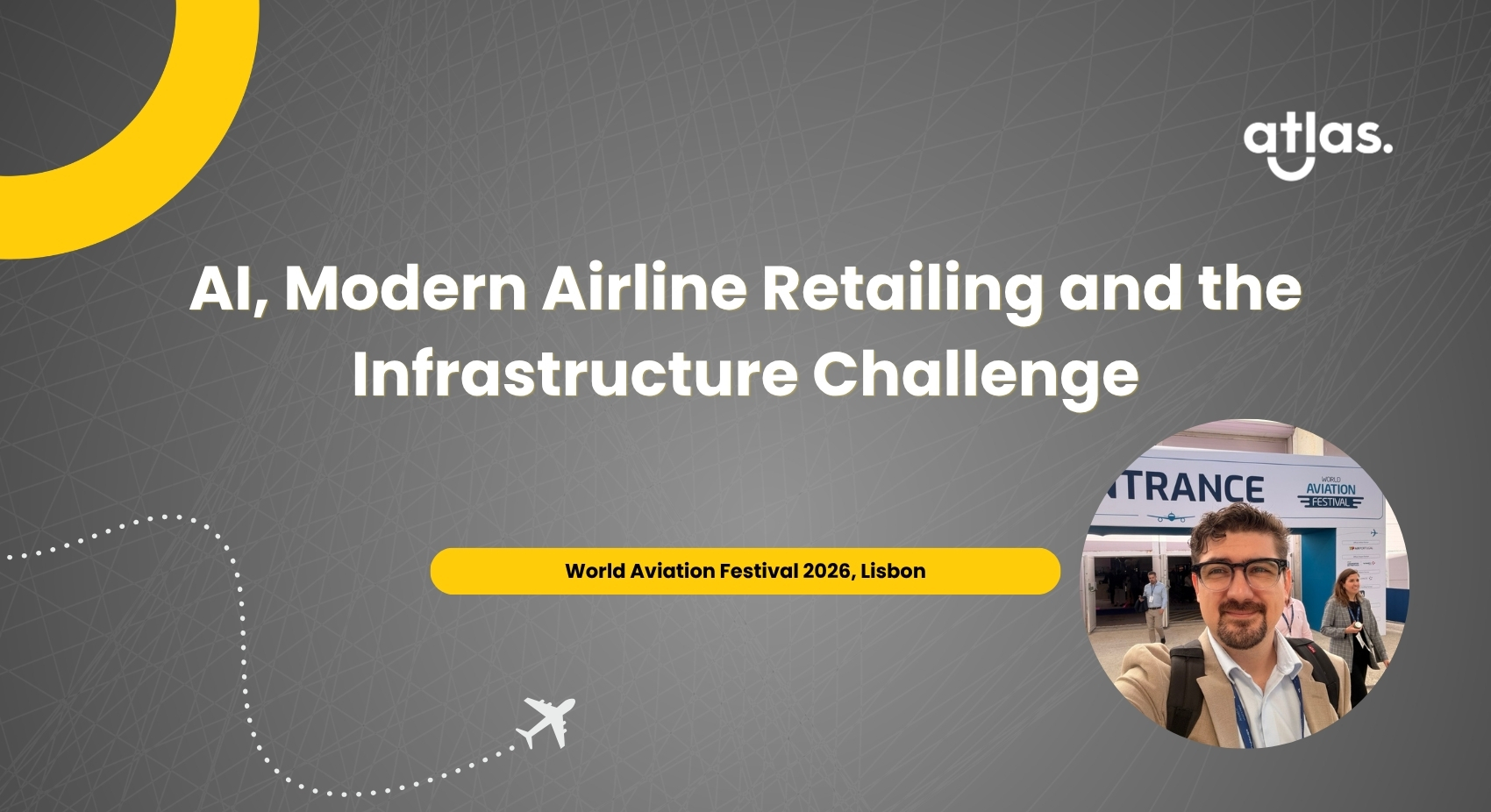
Three days in Lisbon at the World Aviation Festival, and I came back with quite a few thoughts about where our industry is heading.
What struck me the most this year was a noticeable change in the overall mood. Less excitement around shiny new solutions and bold promises, and much more focus on what actually works, what it costs, and how quickly we can deliver it.
Innovation hasn’t disappeared. Quite the opposite. But it feels like the industry is becoming more realistic about technology and the value it is expected to bring.
Key takeaways from World Aviation Festival 2026
- Economic pressure is pushing technology towards measurable results. Airlines need solutions that improve efficiency, protect profitability and deliver value without adding unnecessary complexity.
- AI and modern airline retailing are moving from ambition towards execution. Faster development, flexible offers and better passenger experiences are becoming more achievable, but existing systems remain a challenge.
- Data and infrastructure will determine how far innovation can go. Clean, structured airline content, reliable connectivity and the ability to complete and service transactions are increasingly important for both traditional and AI-driven distribution.
Economic pressure is changing the conversation
One thing that was hard to ignore was the number of airline representatives who couldn’t make it to Lisbon. Some of my own meetings were cancelled, with rising costs and tighter travel budgets being among the reasons.
And this reflected a broader theme across the discussions.
Demand for travel remains relatively strong, but airlines are operating in a much more challenging environment. Fuel prices, geopolitical instability and growing pressure on profitability are forcing companies to reconsider priorities.
There is also an interesting shift in passenger behaviour. Premium travellers seem to be holding up better, while the more price-sensitive segment is becoming increasingly cautious. Booking windows are changing in some markets too, creating additional challenges for forecasting, pricing and inventory management.
All of this puts additional pressure on technology providers.
It’s no longer enough to bring something innovative to the table. We need to demonstrate how it improves efficiency, reduces costs or creates additional revenue, preferably without introducing another layer of complexity.
And frankly, I think this is a healthy development. Aviation has never lacked ambitious ideas. The harder part has always been making them work commercially and operationally, at scale.
AI is growing up, and delivery matters more than ever
AI was still everywhere at World Aviation Festival, but the conversations felt different compared to previous years.
We seem to be moving away from treating AI as a holy grail that will solve every problem, transform every department and replace half the workforce.
Instead, there is a much more practical understanding that AI should augment existing capabilities, help teams become more productive and improve processes that are often unnecessarily complicated.
What I particularly liked was seeing more practical use cases, experimentation and actual implementations, rather than just theoretical presentations of what might become possible someday.
There was also an interesting point about focus. With so many possible AI applications, it’s easy to spread resources across dozens of initiatives without delivering meaningful results. Perhaps the better approach is to identify a handful of opportunities where AI can make a measurable difference and concentrate efforts there.
For me, however, one of the biggest opportunities is the speed of delivery.
Aviation has spent decades building highly complex systems, many of which are still at the centre of our operations. Modernising them isn’t something we can accomplish overnight.
But AI can help accelerate development, shorten the journey from an idea to a working MVP and make experimentation significantly more accessible.
This doesn’t mean we can simply replace the existing infrastructure with AI. The limitations of the underlying systems will still exist. What changes is our ability to build, test and improve new solutions around them while gradually moving towards a more modern architecture.
And that could be tremendously valuable for an industry where technological transformation traditionally takes years.
The opportunity is no longer just about what AI can do. It’s about how effectively we can apply it, how quickly we can deliver, and whether the results actually improve the way our industry operates.
Modern retailing: Great ambitions, complicated foundations
We’ve been talking about Offer & Order, personalisation and truly modern airline retailing for years.
The ambition is clear. Move beyond selling seats under rigid fare conditions and towards offering relevant products and services based on what individual travellers actually need.
But the reality is that our industry’s architecture is still largely built around legacy processes, and these were never designed for the flexibility we are now expecting.
This creates an interesting contradiction.
On one hand, AI is making increasingly sophisticated personalisation and shopping experiences possible. On the other hand, the underlying systems often struggle to deliver the product flexibility that those experiences require.
This is where I see attribute-based retailing becoming particularly important.
Rather than relying exclusively on predefined branded fares and bundles, airlines should be able to expose individual product attributes and allow more flexible packaging around passenger preferences.
And there is another part of this discussion I find equally important: not everything needs to be sold during the initial booking.
We’ve become quite accustomed to presenting passengers with a long list of ancillaries before they even complete their purchase. But does a traveller really need to decide on every possible additional service at that moment?
There are multiple opportunities throughout the journey, from post-booking interactions to check-in, disruptions and loyalty engagement, where a relevant offer might make much more sense.
The objective should be to understand the passengers and present the right options when they are actually useful, rather than simply maximising the number of products displayed.
This is particularly relevant as younger generations, who have grown up with unbundled airline products, become an increasingly important customer segment.
Structured data might be the most important part of the AI discussion
One of the points that resonated with me most came during a discussion involving ATPCO.
We can talk endlessly about intelligent shopping assistants, personalised offers and AI agents capable of handling entire journeys. But none of this works particularly well without the right foundation.
AI needs clean, structured and accessible data to deliver reliable results.
And aviation has quite a challenge here.
Content is distributed across different standards, interfaces and systems, often with inconsistent product descriptions and varying levels of detail.
Even when the information exists, it isn’t necessarily structured in a way that allows intelligent systems to understand, compare or act on it effectively.
This is becoming increasingly important as the way consumers discover travel begins to change.
Instead of searching through dozens of websites, travellers are starting to ask AI assistants where to go, which airline to choose and what options best fit their preferences.
The traditional search and distribution journey is no longer the only possible entry point.
For airlines, distributors and technology providers, this creates both an opportunity and a challenge. Being technically connected is one thing. Making your products understandable, discoverable and actionable for AI-driven channels is another.
And being discoverable is only the beginning.
If an AI agent recommends a particular flight, it also needs to know that the fare is accurate, the product is available and the booking can actually be completed. If the traveller later needs to change a flight or request a refund, the infrastructure must be able to support that too.
This is something I believe we need to pay much more attention to as AI-driven travel experiences develop.
The quality of the experience will depend not only on how intelligently a system recommends a product, but also on how reliably it can deliver what was promised.
For me, that is where the discussion about structured data, modern distribution and fulfilment starts to come together.
And I believe those who invest in getting their data foundations right today will have a significant advantage tomorrow.
From reacting to anticipating passenger needs
Another interesting direction is the growing application of AI in airline operations and passenger servicing.
Predicting disruptions, improving aircraft turnaround processes, automating routine customer interactions and supporting rebooking are all examples of technology moving beyond experimentation.
But I think the bigger opportunity is not simply automating what happens after something goes wrong. It’s anticipating what the passenger might need.
Imagine receiving a useful update before you even realise your connection is at risk, or being offered a practical alternative before having to contact customer support.
The technology doesn’t necessarily have to eliminate every disruption. Sometimes providing the right information at the right moment can already make a significant difference.
And again, we’re coming back to the same requirements: good data, reliable connectivity between systems and the ability to act on information rather than simply display it.
Looking ahead: Innovation needs infrastructure that can deliver
Despite all the challenges, I left Lisbon feeling quite positive about the technological direction our industry is taking.
Not because we’ve suddenly solved the problems we’ve been discussing for the past decade, but because the conversation is becoming more grounded in reality.
We’re moving towards a world where technology isn’t judged by how impressive the presentation looks, but by how well it solves actual problems. Where AI becomes part of the way we work rather than a separate initiative, and where modern distribution is no longer simply about connecting more content, but about making that content accessible, flexible and ready for the next generation of travel retailing.
And across many of the discussions in Lisbon, I kept coming back to the same thought: innovation can only go as far as the infrastructure behind it allows.
This is also why I’m increasingly confident about the direction we’re taking at Atlas.
Our focus is on building infrastructure that makes complex airline content easier to access, retail and service at scale. It’s not just about connecting airlines and travel sellers, but about making sure the entire journey works reliably, from search and booking through to payments, fulfilment and post-booking operations.
We can’t remove every limitation that exists across the airline industry. But by investing in our own technology and strengthening the data, connectivity and operational capabilities behind it, we can make that complexity easier for travel businesses and builders to manage.
And as AI opens new ways for travellers to discover, book and manage their journeys, I believe those foundations will become even more valuable.
There is still plenty of work ahead, and the transition certainly won’t happen overnight.
But for the first time in a while, it feels like the technology, the industry expectations and the actual business needs are starting to align.
And that’s a future I’m genuinely excited to be part of.