

For years, Low-Cost Carrier (LCC) retailing has been boxed into an uncomfortable trade-off.
If you want coverage, you sacrifice speed.
If you want real-time accuracy, you pay for bloated infrastructure.
And if you expect post-booking service like ancillary upselling and refunds, you’re told: “That’s just not how LCCs work.”
Wei Zhang doesn’t buy that.
At the Alibaba Cloud PolarDB Developer Conference, Atlas’s Chief Product & Technology Officer stood in front of more than 30 CTOs and engineering leaders and made a simple point that landed hard:
The so-called “impossible trilemma” of air distribution isn’t a law of physics. It’s the result of outdated architecture.
And once you hear how Atlas rebuilt its foundation, it’s hard to un-hear it.
The Real Pain Isn’t Speed or Coverage, It’s Fragmentation
Most Travel Sellers never see what actually happens behind a flight search. The ones that do, worked around it without addressing the root cause.
Supporting 140+ low-cost carriers means dealing with:
- wildly inconsistent APIs and protocols
- unsynchronised inventory that looks bookable… until it isn’t
- latency that kills conversion
- post-booking flows so fragmented that refunds become manual firefighting
This isn’t just technical debt. It’s commercial drag:
- failed bookings = lost revenue
- slow responses = abandoned carts
- manual refunds = unhappy customers and burned ops teams
“The industry keeps patching the surface,” Wei explained, “but the real cost sits underneath, in how data is stored, moved, and trusted.”
Why Atlas Started with Cost, Not AI Buzzwords
Here’s where Wei’s personality really shows.
While many companies talk about AI as a feature, Team Atlas’s focus goes in the opposite direction:
“If your architecture isn’t cost-efficient, your AI will never scale.”
Atlas’s answer starts with Alibaba Cloud PolarDB, not because it’s flashy, but because it removes structural waste.
What actually mattered:
- Storage–compute separation
Atlas can absorb sudden query spikes without over-provisioning. Business volatility stops being a cost bomb and becomes a controlled variable. - Global Database Network (GDN)
Enterprise-grade and cross-region data consistency, without building and maintaining it in-house.
“For enterprise users like us,” Wei said plainly, “The most fundamental value is cost efficiency.”
No theatrics. Just engineering reality.
From “Query–Response” to “Predict–Confirm”
This foundation unlocked something bigger.
Instead of shuttling data between systems to train AI models, Atlas embeds AI training and inference directly inside PolarDB.
The result?
- no complex data movement pipelines
- faster adaptation to new LCC rules, pricing behaviour, and post-booking terms
- fewer failure points
Wei summed it up with a line that drew smiles across the room:

“Technically speaking, simplicity is elegance.”
And that simplicity enables Atlas’s biggest shift yet, moving the industry from query–response to predict–confirm.
What This Means in Practice (Not Theory)
This isn’t architecture for architecture’s sake. It shows up where Travel Sellers feel it most:
| What Matters | Atlas | Industry Norm |
| Bookability rate | >94% | 85-90% |
| LCC coverage | ~100% | ~85–95% |
| P99 response time | <300ms | 500ms – 2000ms+ |
| Refund processing | <15 minutes | Days to weeks |
| Infrastructure cost | 30% reduction | Baseline |
Post-booking doesn’t have to be “impossible”.
Accuracy doesn’t have to fight speed.
And scale doesn’t have to mean runaway costs.
AI Isn’t a Feature at Atlas – It’s the Product
Wei ended with a distinction that clearly separates Atlas from the noise:
“AI is not a feature for us. It’s the core. It’s not a tool – it’s the product.”
While others use AI to optimise existing workflows, Atlas uses it to redefine them. The prediction engine isn’t an add-on, it is the service.
That’s how Atlas systematically resolves the trilemma others still treat as a fact of life.
The Bigger Shift the Industry Is Finally Making
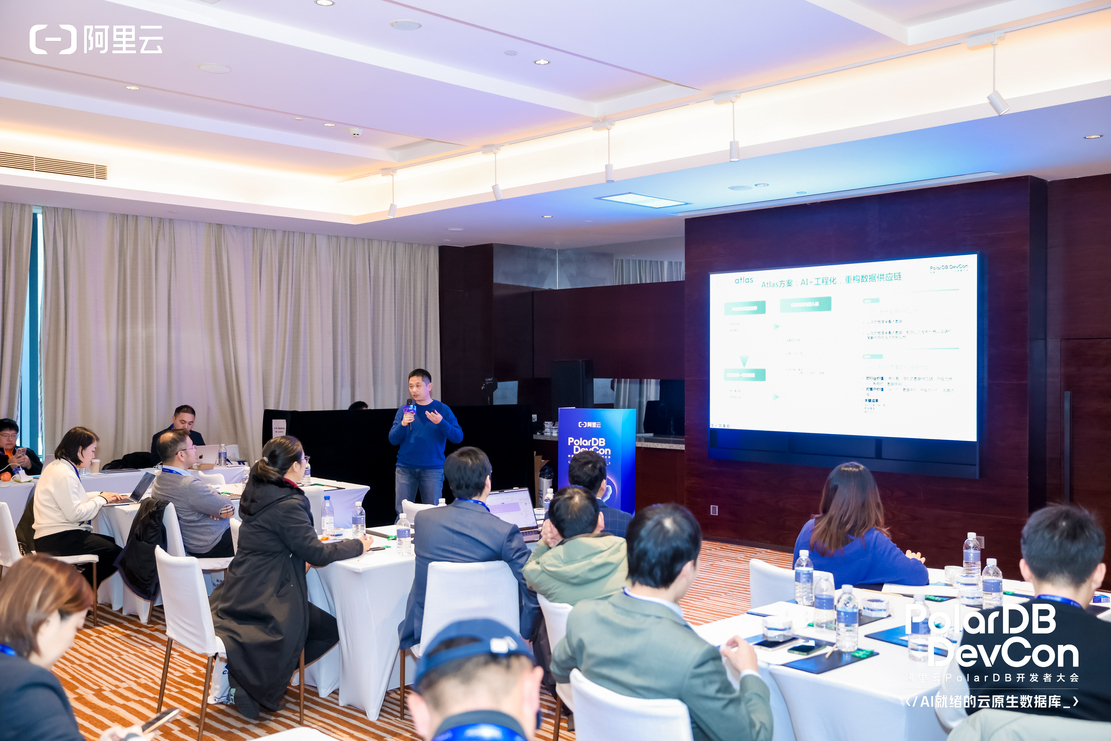 The strongest takeaway from the conference wasn’t about databases or latency.
It was this:
The industry is moving from “using AI to solve isolated problems” to “re-architecting infrastructure for AI.”
Atlas has already crossed that line.
By stepping out of the crowded data supply chain race and into intelligent decision-making, Atlas isn’t just competing differently; it’s defining the category.
The old limits weren’t truths.
They were artifacts of old systems.
With PolarDB as its foundation, Atlas is rebuilding how global LCC flight retailing actually works.
Learn more at https://atlaslovestravel.com/ or connect with Team Atlas to explore true definition of scaling LCC retailing.
Frequently Asked Questions (FAQs)
Low-Cost Carrier (LCC) APIs often suffer from fragmented infrastructure, unsynchronised inventory, inconsistent rule logic, and latency issues. Unlike traditional GDS-based distribution, many LCC systems were not originally designed for high-volume third-party retail.
Atlas addresses this by combining direct LCC integrations with predictive validation powered by Alibaba Cloud PolarDB, reducing stale inventory exposure and improving bookability to >94%.
In today’s OTA environment, pricing accuracy below 95% creates operational risk. Many aggregators operate in the 85–92% range for LCC content.
Atlas maintains ~97% cache fare accuracy by embedding AI-driven validation directly within its database layer on Alibaba Cloud PolarDB, helping OTAs sell LCC content with higher operational confidence.
High latency (500ms–2000ms+) reduces search competitiveness and increases drop-off rates during checkout. Sub-300ms P99 response times significantly improve:
- Search-to-book conversion
- Meta platform competitiveness
- Mobile session retention
- Checkout completion rates
Atlas consistently delivers <300ms P99 response times at scale
Traditional consolidators and aggregators often introduce additional layers of latency and rule transformation by sourcing from third-party suppliers, increasing failure points.
Atlas integrates directly with 140+ LCC APIs and optimises retail logic at the infrastructure level, improving:
- Bookability rate
- Ancillary upsell consistency
- Rule transparency
- Post-booking automation
LCC pricing logic changes frequently, creating instability for static systems.
Atlas embeds adaptive AI training and inference directly inside its database architecture. This allows faster adaptation to rule volatility without rebuilding data pipelines or deploying major system updates.