

Why Travel Automation Must Learn to Think
Travel is a powerful engine for global connection. But behind every journey sits a dense layer of operational complexity that Travel Sellers and OTAs must manage every day—especially when distributing low-cost carriers (LCCs).
This complexity stems from the scale and diversity of modern LCC operations, including:
- System diversity: Multiple platforms, data formats, and commercial models with limited global standardisation
- Real-time dynamics: Constant changes in pricing, availability, fare rules, and ancillaries
- Post-booking demands: Disruptions and servicing scenarios that require fast, context-aware decisions
Atlas is a technology company built on AI and automation. This foundation allows us to transform faster, operate more efficiently with lean team, and deliver higher-quality outcomes across travel operations.
In our early phase, Atlas relied on rule-based Digital Employees to manage high-volume, repeatable work. This enabled us to scale low-cost carrier (LCC) integrations, maintain data accuracy, and operate reliably across global markets. It remains a critical part of our platform.
However, travel operations have grown more complex. Pricing, availability, fare rules, and post-booking scenarios change continuously. While rule-based automation excels at execution, it is limited when conditions shift and decisions require context.
To continue delivering accuracy, resilience, and a superior customer experience, Atlas is evolving to autonomous AI agents. Agentic AI enables systems that can reason across data, make multi-step decisions, and adapt in real time—reducing operational friction while improving service quality.
This shift is not a replacement of what came before. It is a continuation of our AI-first strategy. Today, Atlas’s operations teams manage and orchestrate AI agents, redefining how customer service and travel operations are delivered at scale—and setting a new standard the legacy industry cannot easily follow.
Phase I: The Foundation — Digital Employees and Rule-Based Automation
Our first phase focused on a core principle: let software handle repetitive, high-volume work so humans can focus on strategy. We developed purpose-built Digital Employees—such as Athena, Brigitte, Carmen, Doris and Florence—to manage specific domains:
- Airline data validation: Continuous monitoring of fragmented sources.
- Ticketing exceptions: Automating servicing checks.
- Financial reconciliation: Reducing cycles from weeks to days.
- System oversight: Shifting from reactive fixes to proactive monitoring.
The impact:
- Integrated 140+ LCCs through a single standardised API.
- Maintained consistent data quality across disparate sources.
- Empowered lean human teams to focus on platform innovation rather than Tier-1 tasks.
The Automation Ceiling: Where Rules Stop Working
Despite its reliability, rule-based automation (RPA) has inherent limits. RPA performs best when inputs are predictable and rules remain stable. However, modern travel is rarely stable:
- Real-time volatility: Airline schedules and fare rules change by the minute.
- Contextual exceptions: Static workflows stall when encountering “off-script” scenarios.
- Operational overhead: Every new exception requires manual intervention, creating an “automation ceiling.”
In LCC distribution, where ancillaries drive revenue and data formats are inconsistent, scaling via more rules only increases complexity. The solution is no longer more automation; it is intelligence.
Phase II: Autonomous AI Agents — From Execution to Reasoning
AI agents represent a fundamental shift in how automation operates. A Digital Employee follows instructions while an AI Agent pursues outcomes.
AI agents are autonomous systems capable of:
- Interpreting operational context
- Reasoning across multiple data sources
- Planning and executing multi-step actions
- Adapting to changing conditions in real time
- Collaborating with other agents
- Learning from outcomes
Instead of executing a predefined workflow, an agent is given an objective—such as resolving a disrupted booking within airline policy and customer preferences—and determines how best to achieve it.
This marks the transition from process automation to cognitive automation.
Collective Intelligence: The Multi-Agent Network
The true power of agentic AI emerges through collaboration.
Atlas’s vision is not a single monolithic agent, but a network of specialised agents—each responsible for a specific domain, such as:
- Pricing & Finance Agents: Assessing commercial impact in real time.
- Rules & Ancillary Agents: Ensuring compliance with airline policies.
- Sentiment & Preference Agents: Tailoring solutions to customer history.
- Communication Agents: Managing seamless notifications and confirmations.
For example:
- One agent analyses real-time flight availability
- Another evaluates fare rules and ancillary options
- A third assesses customer history and preferences
- A fourth manages confirmation and communication
This “Collective Intelligence” allows for nuanced decision-making that no static system can match.
EVA: An AI Agent in Production
This shift is already live at Atlas.
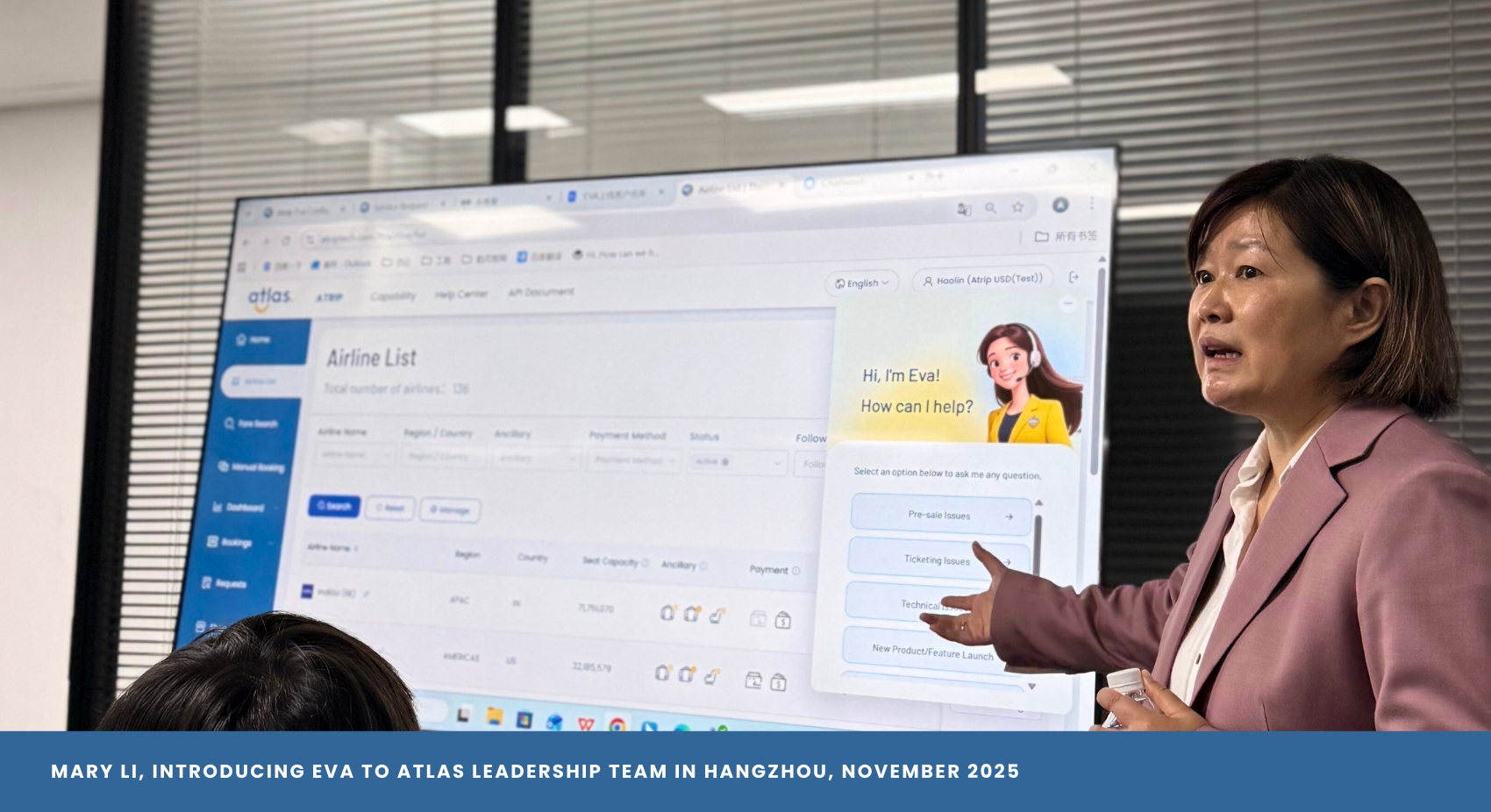
EVA, Atlas’s AI agent, is designed to reshape the customer service experience for Travel Sellers and partners. Unlike traditional chatbots, EVA is not limited to scripted responses or FAQs.
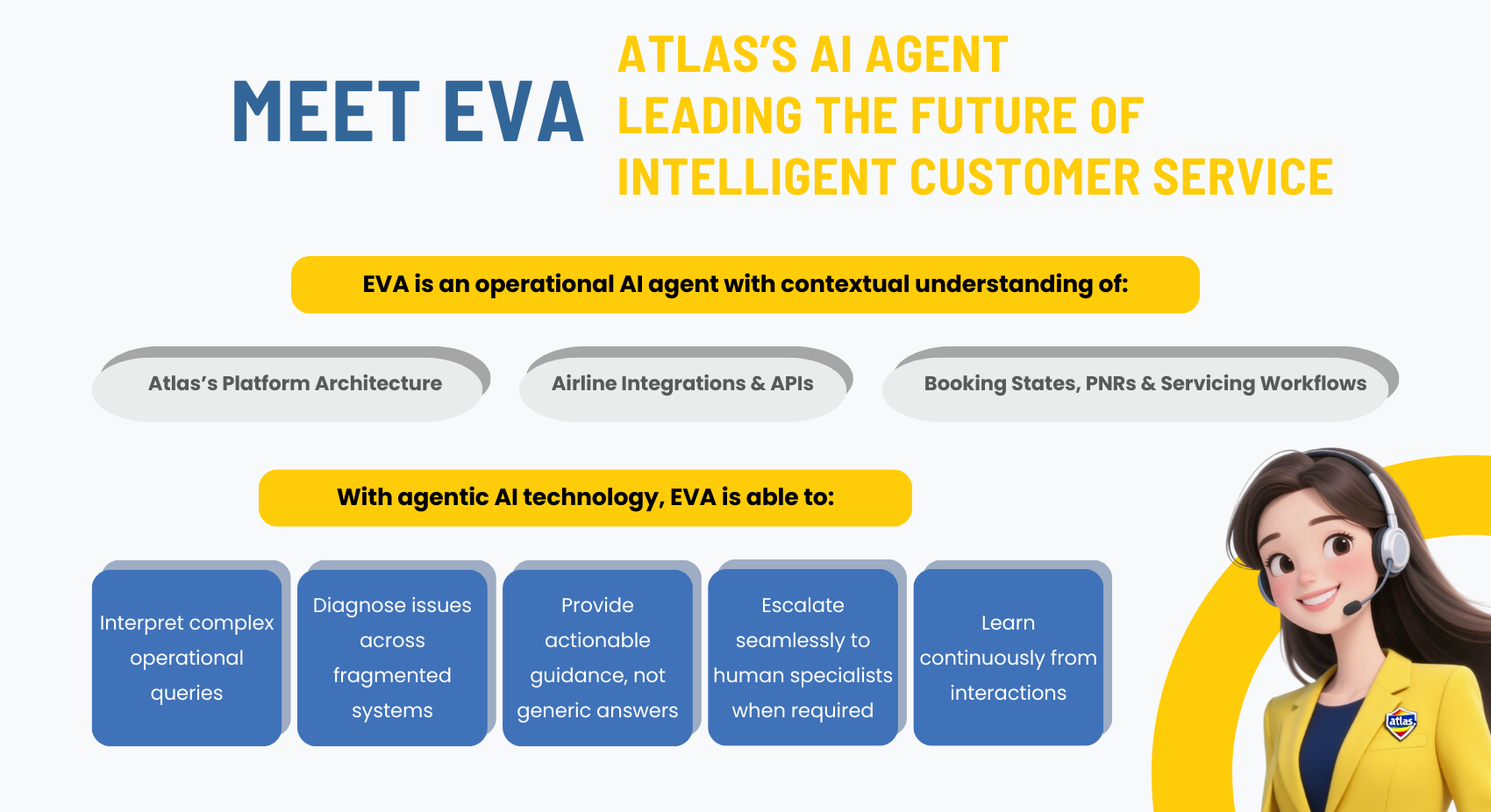
EVA handles Tier-2 complexity—the gap between simple automation and specialist human expertise. She reduces resolution times and ticket volumes by providing actionable guidance and diagnosing issues across the infrastructure, learning from every interaction to improve future performance.
More importantly, EVA signals the future direction of Atlas: AI agents that move beyond support into execution, coordination, and decision-making.
Looking Ahead: AI Orchestration
Autonomous agents are not the end goal. They are the building blocks.
The long-term objective is AI orchestration—a coordinated intelligence layer where multiple AI agents dynamically manage end-to-end travel operations.
In an orchestrated model:
- Agents do not act in isolation
- Objectives are optimised across the full journey lifecycle
- Decisions balance commercial, operational, and customer outcomes
- Human teams define strategy and guardrails, not workflows
This orchestration layer transforms fragmentation into advantage—connecting booking, servicing, disruption management, finance, and customer experience into a cohesive, intelligent system.
Conclusion: Turning Fragmentation into Advantage
Atlas’s evolution from Digital Employees to autonomous AI agents is not a technology trend—it is a strategic response to the realities of modern travel.
- Rule-based automation delivered scale and consistency
- Agentic AI delivers resilience, intelligence, and adaptability
Together, they position Atlas as:
- A complete LCC retailing and analytics solution
- A trusted partner to over 140 low-cost carriers
- A one-stop API platform for global Travel Sellers
- A travel-tech company built for what comes next
In an industry defined by complexity, Atlas is proving that intelligence—not just automation is the key to unlocking better travel for everyone.
Discover Atlas’s AI-driven platform to experience an AI-first technology in smarter LCC distribution.
Frequently-Asked Questions (FAQ)
What is the difference between a Digital Employee and an AI Agent?
A Digital Employee follows predefined rules. An AI Agent understands intent, reasons across data, and acts autonomously in dynamic scenarios.
Is EVA just a chatbot?
No. EVA is an autonomous AI Agent capable of reasoning, orchestration, and decision-making across systems.
Why are AI Agents important for LCC retailing?
LCC retailing is highly fragmented and volatile. AI Agents manage ambiguity, disruption, and personalisation at scale.
How does Atlas support over 140 LCCs efficiently?
Through a standardised, end-to-end API with full ancillary support and embedded intelligence.
Do AI Agents replace human agents?
No. They augment human teams by handling complexity and volume while escalating when judgement is required.